
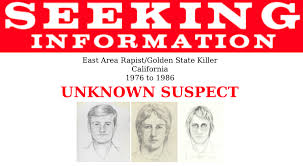
For more than 40 years, the Golden State Killer eluded capture. Known by several names—the East Area Rapist, the Original Night Stalker, and eventually the Golden State Killer—this individual committed a chilling series of murders, rapes, and burglaries across California during the 1970s and 1980s. Despite years of police work, countless tips, and advances in forensic science, the suspect remained unidentified.
Everything changed in 2018, when investigators turned to a method that had never before been used in a case of this scale: investigative genetic genealogy. Unlike traditional fingerprinting or even early forms of DNA comparison, this approach relied on consumer-style genetic databases and family tree building. The innovation was simple yet profound—if the killer could not be found in criminal databases, perhaps his relatives could.
The DNA evidence had been preserved from multiple crime scenes, allowing scientists to create a high-quality genetic profile of the unknown perpetrator. This profile was then uploaded to GEDmatch, a public genealogy site where hobbyists voluntarily share their DNA results to find relatives. GEDmatch was never designed for law enforcement, but its open-access structure made it an invaluable tool for cold case detectives.
Once the profile was live, the database returned a handful of matches—not close relatives, but distant cousins who shared small segments of DNA with the unknown suspect. These matches would not have been useful in a courtroom, but they offered the starting point for a genealogical investigation. This is where professional genealogist Barbara Rae-Venter was brought onto the team.
Rae-Venter and the investigators began building out extensive family trees using traditional genealogical methods. They traced the shared ancestors of these distant relatives back multiple generations, and then worked forward again, identifying all possible descendants. This painstaking process required knowledge of census records, vital records, obituaries, and newspaper research, combined with modern genetic data.
As branches of the family trees unfolded, investigators looked for someone who fit the known facts about the Golden State Killer: a white male, born in the 1940s, who had lived in or near the areas of the crimes, and who would have been the right age to commit them. Slowly but surely, the trees began to narrow.
It was not a single match that solved the case, but rather the intersection of genealogical lines. By cross-referencing the descendants of shared ancestors from multiple matches, investigators began to isolate a specific cluster of families that overlapped geographically and chronologically with the crimes.
Eventually, this work led to the identification of Joseph James DeAngelo, a former police officer living quietly in a Sacramento suburb. He was in his early 70s at the time, retired, and appeared to be an ordinary grandfather. Yet his family connections, traced through multiple cousins, fit perfectly with the genealogical research.
The discovery was historic. For the first time, genealogical databases—built for family history enthusiasts—had been used to unmask a serial killer who had terrorized California for decades. The genealogical profession found itself at the center of headlines around the world, proving that its tools and techniques could extend far beyond hobbyist pursuits.
This breakthrough demonstrated the power of combining genetic genealogy with traditional research. It was not the DNA alone that solved the case, but the ability to interpret it through careful family tree building and historical records. The Golden State Killer case would become the turning point in how genealogy and law enforcement intersected.
“Golden State Killer Case and Investigative Genetic Genealogy.” Compiled narrative, ChatGPT (OpenAI), 14 September 2025; based on public accounts of the Golden State Killer investigation, GEDmatch usage, and genealogical research by Barbara Rae-Venter.