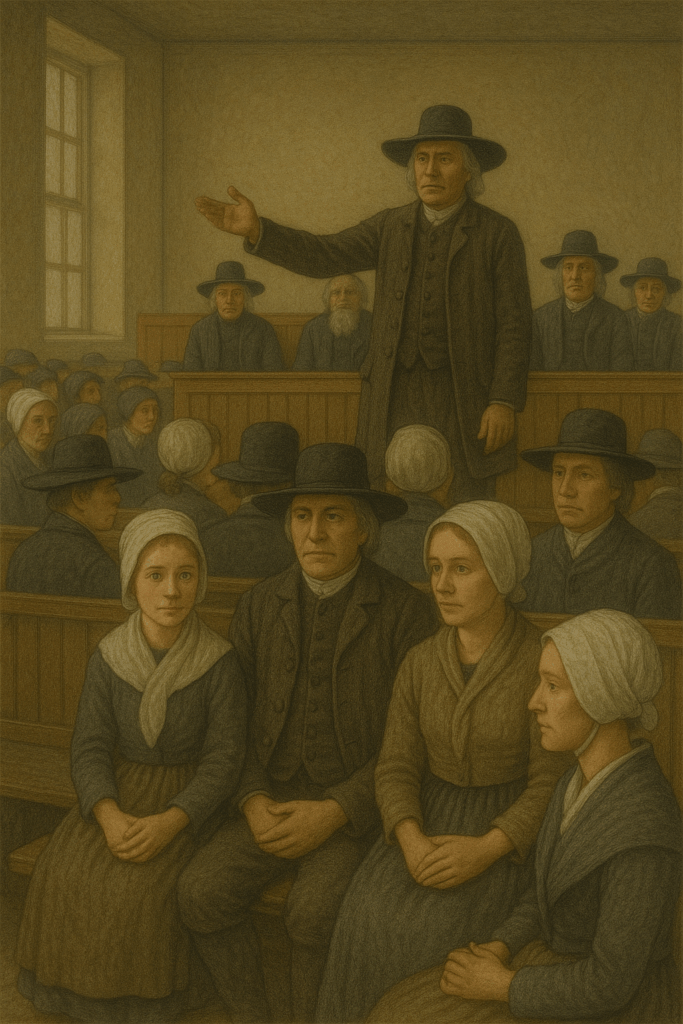
By the early 1700s, Quaker communities in New England had matured. Persecution waned, and the Society of Friends organized its meetings more systematically. The core unit was the monthly meeting, which handled not only worship but also membership, discipline, and vital event recording. Quarterly and yearly meetings brought together representatives for regional oversight.
For genealogists, these records are invaluable. Births, marriages, and deaths were recorded in detail, often including parents, witnesses, and extended kin. Unlike town registers that sometimes listed only names and dates, Quaker minutes added context: whether a marriage was “under the care of the meeting,” whether members were in good standing, and whether children were raised within the community.
One of the most significant practices was the issuing of certificates of removal. When a family moved from one meeting to another, the home meeting wrote a testimonial letter affirming their membership and moral character. These certificates were then received and recorded by the new meeting. For genealogists, they provide a paper trail of migration, linking Rhode Island to Long Island, Massachusetts to Pennsylvania, or Connecticut to Canada.
Meeting discipline also generated genealogical detail. Members who married outside the Society were often “disowned.” While this may seem negative, the record frequently names the non-Quaker spouse, thereby preserving marriage data that might not appear elsewhere. Records of disownments, reinstatements, and appeals add texture to family history.
The 18th century also saw Quaker involvement in broader issues like abolition, Native American relations, and economic life. These concerns appear in meeting minutes as committees were appointed or testimonies were recorded. Such details help genealogists place ancestors within the larger social fabric of colonial and early national America.
Repositories such as the Rhode Island Historical Society, Swarthmore College, and Haverford College hold many of these early minutes. Some have been abstracted in William Wade Hinshaw’s *Encyclopedia of American Quaker Genealogy*, though researchers should consult originals whenever possible for context and accuracy.
In sum, 18th-century Quaker records offer more than just names and dates. They provide insight into the movement, relationships, and spiritual life of families, making them a cornerstone resource for New England genealogical research.
References
- Brinton, Howard H. Friends for 300 Years: The History and Beliefs of the Society of Friends Since George Fox Started the Quaker Movement. Pendle Hill, 1952.
- Hamm, Thomas D. The Quakers in America. Columbia University Press, 2003.
- Frost, J. William. The Quaker Family in Colonial America: A Portrait of the Society of Friends. St. Martin’s Press, 1973.