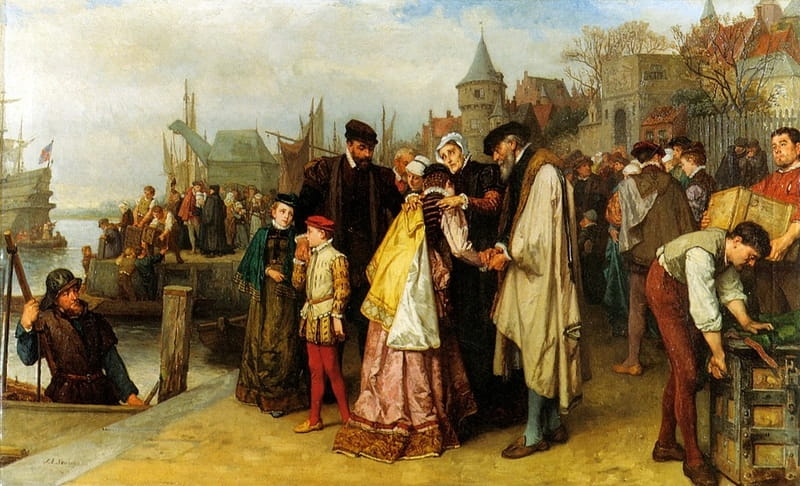
Researching Huguenot ancestors requires strategies that account for both the destruction of records in France and the dispersal of communities across many countries. Genealogists must learn to trace migrations, interpret multiple languages, and integrate religious and civil sources.
One strategy is to identify surnames. Many Huguenot names remained distinctive even after generations abroad. Lists of common Huguenot surnames, maintained by societies and researchers, can alert genealogists to possible connections.
Another is to follow migration chains. Families often moved step by step: from France to the Netherlands, then to England, and finally to America. Certificates of naturalization, church registers, and community petitions can confirm each stage of the journey.
Correlating secular and religious records is vital. A baptism recorded in a Huguenot church may correspond with a naturalization entry or a land grant. Together, they create a stronger proof of identity. Apprenticeship records, guild lists, and probate files also place Huguenots in their social and economic context.
Naming patterns can be another clue. Many Huguenots favored biblical names such as Isaac, Jacob, or Esther, and repeated them across generations. Combined with distinctive surnames, these patterns help distinguish families in records.
Modern resources have made Huguenot research more accessible. DNA testing can confirm relationships across dispersed lines. Digital archives provide access to society publications and original registers. Genealogists should also make use of local historical societies, many of which curate Huguenot collections.
Ultimately, the key is persistence. Huguenot families often left fragmented records, but by piecing together fragments across countries and centuries, genealogists can reconstruct their stories. The reward is a family history that connects to one of the most dramatic migrations of the early modern period.
References
- William A. Pettigrew. Freedom’s Debt: The Royal African Company and the Politics of the Atlantic Slave Trade, 1672–1752. UNC Press, 2013.
- Robin Gwynn. Huguenot Heritage. Sussex Academic Press, 2001.
- Huguenot Society of America. Genealogical Records and Publications.